

CrossFit in Düsseldorf. All-around strong.
CrossFit combines strength training, conditioning, weightlifting and bodyweight movements into one structured training system. In our CrossFit classes you train in small groups, guided by qualified coaches, with a workout matched to your experience and current fitness level.
You don't need to do pull-ups, bring barbell experience or "get fit first" before you start. You'll build technique, strength and conditioning step by step in training.
Different workouts. One clear system.
CrossFit is strength and conditioning training that keeps recombining functional movements and performs them at an intensity that suits you individually. Think squatting, lifting, pressing, pulling, carrying, running, rowing and jumping.
The variety is not an end in itself. Different movements, loads, rep schemes and time formats create different training stimuli. One day the focus might be strength, another day endurance, technique or combining several skills at once.
The goal is not to specialize in a single discipline. You develop a broad physical base that makes you more resilient in training, in other sports and in everyday life.
In regular training, not everyone has to move the same weight or work at the same speed. Movements, loads, reps and range of motion are adapted to your experience and current abilities.
Everyone trains toward the same goal – but not necessarily with the same variation or the same weight.
What does CrossFit train?
CrossFit doesn't define fitness by a single strength, but by ten physical skills.
Taking in, transporting and using oxygen over sustained efforts.
Sustaining output and repeated work over a period of time.
Overcoming resistance with control and moving external loads.
Using your joints through a sound range of motion with control.
Producing force in a short time and moving explosively.
Performing repeated movements quickly and efficiently.
Combining several movement patterns in a controlled way.
Switching between movements and directions quickly and safely.
Controlling your body and its center of gravity.
Directing movement precisely at the intended target and intensity.
Not every class emphasizes all of these skills equally. Over weeks and training cycles, though, they add up to a varied program that develops different strengths and avoids one-sided training.
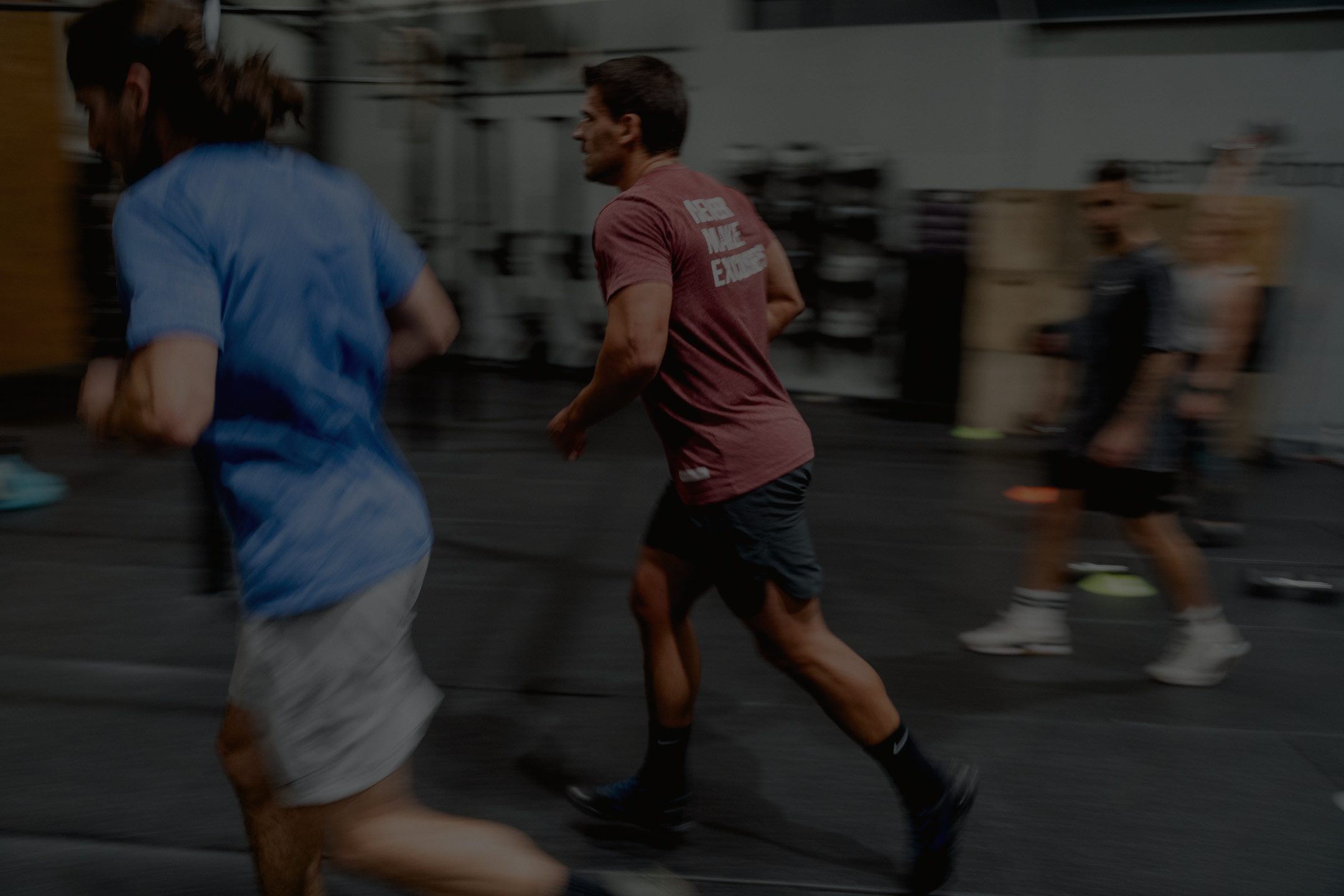
Run. Lift. Pull. Push.
Many CrossFit movements will look familiar from other sports or everyday life. What changes is how they are learned, combined and built into your training. The foundation is basic movement patterns such as squatting, hinging, pushing, pulling, carrying and locomotion. More complex movements build on them step by step.
Conditioning – your endurance engine
Conditioning trains your ability to produce output over short or longer efforts.
- Running
- Rowing
- BikeErg
- Air Bike
- SkiErg
- Jump Rope
Key focus: endurance, pacing, breath control and the ability to handle repeated efforts.
Gymnastics – control of your own body
In CrossFit, gymnastics covers movements where you mainly move and control your own body.
- Air Squats
- Push-ups
- Ring Rows
- Pull-ups
- Hanging Knee Raises
- Toes-to-Bar
- Dips
- Handstand variations
Key focus: midline stability, relative strength, coordination, balance and controlled positions.
Weightlifting – strength with external load
Here you move barbells, dumbbells, kettlebells, medicine balls and other training equipment.
- Deadlifts
- Front Squats
- Back Squats
- Shoulder Press
- Push Press
- Cleans
- Snatches
- Kettlebell Swings
- Wall Balls
- Farmers Carries
Key focus: strength, strength endurance, power and technique under load.
Instead of pull-ups you might train ring rows or assisted variations. You'll learn the weightlifting movements with a PVC pipe, a light barbell or dumbbells first.
Variety with a plan
A Workout of the Day – WOD for short – is not meant to be merely exhausting or as spectacular as possible. Every session pursues a specific training goal: building strength, refining a movement technically, sustaining steady work, or keeping movement clean at an elevated heart rate.
To do that, CrossFit combines three fundamental training domains. The training stimulus changes not only with the choice of movements, but also with order, load, reps, duration, rest, intensity and movement complexity.
Stimulus: endurance, breath control and pacing.
Stimulus: skill, control and midline stability.
Stimulus: strength, power and technique under load.
Stimulus: controlling your breathing while holding clean positions.
Stimulus: moving load while heart rate and breathing are elevated.
Stimulus: combining relative strength with external load.
Stimulus: endurance, body control and load combined in one workout.
One movement can serve different goals
A deadlift can be performed heavy and controlled as strength work. With lighter weight and more reps, the same movement can be part of a conditioning workout.
Running isn't always the same training either. Short sprints create a different stimulus than longer, steady intervals or runs between strength movements.
Good programming therefore determines not only what you train, but also how the session is structured and what goal it pursues.
Same movements. Different stimulus.
Time, task and rest change how a workout feels and what it trains.
For Time▾
You complete a set task in a time frame that is appropriate for you.
The focus is on efficient movement, smart pacing and a clear finish to the workout.
AMRAP▾
AMRAP stands for "As Many Rounds or Reps as Possible". Within a fixed time you work through as many rounds or reps as you can.
The goal is not to sprint out of the gate, but to find a pace you can hold for the full duration.
EMOM▾
In an "Every Minute on the Minute" workout, a set task starts at the top of every minute. Whatever time remains is rest.
EMOMs work well for technique training, controlled volume and efforts with regularly built-in recovery.
Intervals▾
Work and rest periods alternate in a set pattern.
Depending on length and intensity, intervals can train endurance, speed, strength endurance or your recovery between efforts.
Professionally programmed. Adapted for our members.
Our CrossFit classes run on Mayhem Gym Programming. It gives our training a long-term structure and combines strength, endurance, gymnastics, weightlifting and conditioning in well-coordinated training cycles.
The daily plans include the training goal, the intended stimulus, scaling options and notes for the coaches.
We don't simply run the workouts as written, though. Our coaching team reviews every session and adapts it to our members' needs, our training environment and the specific class.
That way our members benefit from a professional overall program without losing individual coaching on the floor.
Training priorities build on each other over several weeks.
Our coaches explain what the workout is meant to train and how to choose your effort wisely.
Movements, volume and structure can be adjusted to our members' abilities and needs.
Movement variations, loads, reps and intensity are matched to your current level.
60 to 75 minutes. Coached from start to finish.
Depending on the day's content, our CrossFit classes run 60 to 75 minutes. Every session is led by a coach and follows a clear structure. The exact flow depends on the focus of the day.
Briefing
Your coach walks you through the workout, the intended stimulus and the key movements. You'll learn what matters in the session and how to pace your effort.
Warm-up
The warm-up prepares you specifically for the movements ahead: mobility, activation, first technique drills and a gradual build-up of intensity.
Skill or Strength
Depending on the training day you'll work on technique, a gymnastics skill or a strength movement. Not every class includes a separate strength piece – the structure always follows the training goal.
Workout of the Day
The WOD combines one or more movements in a set format. Before you start, you and your coach settle on suitable variations, loads and rep counts.
Cool-down
After the workout there is time to wind down, add some mobility work and briefly talk through the session.
You don't need to know before class which weight or variation is right for you. That's exactly what your coach is there for.
More time for specific skills
Alongside our regular CrossFit classes we offer several specialty formats where you can focus on strength, weightlifting, gymnastics and more. These classes complement your CrossFit training – they don't replace the varied overall program of the regular classes.
Two paths. One training that fits you.
Whether you're completely new to CrossFit or bring experience with you: getting started is simple. You'll get to know the gym, one of our coaches and the training. Then you decide which next step makes sense for you.
Free trial class
You join a regular CrossFit class. Before training we briefly talk about your experience and any limitations. During class you'll get suitable variations for the workout.
Choose your entry
After your trial class, several options are open to you.
In a small group you'll learn key movement patterns, common CrossFit terminology and basic scaling options.
The seminar is not a mandatory requirement.
In a private session you work with a coach on fundamental movements and open questions. A good fit if you'd like an individual start or want specific conditions taken into account.
You can also join our regular CrossFit classes right after your trial. Our coaches will guide you step by step.
Choose your membership
Then pick the plan that fits your training volume and your everyday life.
Train with us
Book a free trial class or a drop-in to get to know the gym, our coaching and the community.
Jump straight into classes
If you're already familiar with CrossFit, you can join our regular classes right away. Before the workout we'll quickly sort out which variations and loads make sense for the day.
Add focus areas
Use our specialty classes and open gym options to work on specific skills or pursue your own training goals.
Good to know before you start
Do I need to be fit before starting CrossFit?▾
No. Training is adjusted so you can start at your current fitness level. You're not competing against the most experienced person in class – you work on a version of the workout that fits you.
Is CrossFit always extremely hard?▾
CrossFit can be intense, but intensity is individual. Not every session is a max effort, and no class needs to leave you completely drained. Load, pace, reps and movements are chosen so you can train with sound technique and a clear purpose.
What happens if I can't do a movement?▾
You'll get a suitable progression or alternative. Pull-ups can be replaced with ring rows, for example. Push-ups can be elevated on a box. Weightlifting movements can be learned with a PVC pipe, a light barbell or dumbbells first.
How often should I train CrossFit?▾
For many people, starting with two to three classes per week fits well into everyday life. How often you train depends on your experience, your goals, your recovery and other sports you do.
How is this different from a regular gym?▾
In a CrossFit class you get a planned workout, structured programming and active coaching. You don't have to build your own training plan, and you train at a set time together with a small group.
Can I combine CrossFit with strength training or endurance sports?▾
Yes. Depending on your training volume, CrossFit can be your main training or complement other sports. The key is planning your overall load sensibly and not making every session maximally intense.
Can I train with existing issues or previous injuries?▾
Let us know about any issues or limitations before training. Many movements can be adapted. For acute or unclear complaints, please check with a doctor or physiotherapist first whether training makes sense in your case.
Can I start right away if I already have CrossFit experience?▾
Yes. You can book a trial class or a drop-in. If you'd like to become a member afterwards, you'll go straight into the regular classes.
Start your CrossFit training now
Experience a CrossFit class with us in Düsseldorf-Pempelfort. You'll get to know the training, one of our coaches and the community – free and with no automatic follow-up booking. Pick a suitable date in the contact form and we'll get back to you with all the details for your trial class.